

After watching several episodes of Bar Rescue, you’ll probably notice Jon often mentioning systems. He always says a bar has no systems and that he has to implement them, but it’s really up to us to figure out what he means and why he thinks they are so important.
To understand what Jon means, I liken systems to procedures, but they are technically not the same. However, they are so inter-related, I’m not alone in using the terms interchangeably. Let’s take a look at the relationship between systems and procedures and try to understand why Jon emphasizes them so much, no matter what word is used.
What is a System?
Maybe you’ve heard the expression, “The whole is greater than the sum of its parts”? That expression is referring to a system. A system is a whole that is made up of a group of parts that work together to achieve a common goal that is not accomplishable by the individual parts themselves.
If we think of a bar as a system, everything from the staff and management to the kitchen equipment and customer service processes interact to create a successful operation, and all of it together creates something that each part cannot create alone.
When people are part of a system, then we have elements that are difficult to measure, like interpersonal tension between owners or employees or the “culture” of the bar. One of the aspects that makes Jon special as a business consultant is that he knows about and is willing to tackle issues in the system that are caused by the people in it. This is why he says that in order to fix a business, he has to fix the owners first.
Fixing people is usually a long and arduous task, so many consultants ignore that aspect of a system, pawn it off onto someone else, or make it a tiny footnote in the list of “fixes” that an organization needs as if it is nothing when it needs to be its own focal point. Jon understands that the attitudes, behaviors, and relationships within a bar can significantly impact its success. He dives deep into these human elements, addressing conflicts, building better communication, and fostering a positive culture. This holistic approach is why his rescues often succeed where others might fail. By prioritizing the human factor, Jon ensures that the entire system, not just the operational procedures, is set up for long-term success.
What is a Procedure?
A procedure is a specific set of steps or actions that need to be followed to complete a task or process. It’s like an instruction manual for how to do something within the larger system. The most common procedures we see in detail on Bar Rescue are the cocktail recipes, although ordering supplies, inventory management, following food recipes, cleaning schedules, checklists for managers, running food to tables, and the “steps of service” are all types of procedures that Jon and his experts teach the staff.
How They Work Together
- Systems Contain Procedures: A system is made up of various procedures. For example, in a bar system, there should be procedures for making drinks, cleaning the bar, taking inventory, and serving customers. Each procedure is a detailed guide on how to perform a particular task, and all the tasks together make up the system. When Jon first enters the bar, it’s often clear that there are no procedures for making drinks, cleaning, or storing food.
- Procedures Support Systems: Procedures help the system run smoothly. When everyone follows the same procedures, it ensures consistency and reliability. For instance, if all bartenders follow the same drink-making procedure, every cocktail tastes the same, ensuring customer satisfaction. This is of huge concern to Jon because inconsistency is an issue in almost every failing bar he rescues.
- Systems Ensure Coordination: The system ensures that all the procedures are coordinated and work together efficiently. It’s like a well-coordinated bar shift where each staff member knows their role and tasks. The system (the bar shift) only works well if everyone follows the procedures they’ve been assigned (roles). When a bartender gets drunk and can’t perform their duties well or the manager doesn’t help out where needed, the system fails. Jon and his experts often focus on communication between employees because communication is key to ensuring coordination between employees and within and between subsystems.
- Feedback and Adaptation: Systems include feedback loops to monitor performance and make improvements. If a procedure isn’t working well, feedback helps identify the problem, and the procedure can be adapted to better support the system. For example, if customers complain about slow service, the bar might revise its serving procedures to speed things up, or the manager might pull a bartender from behind the bar and put them on service to adjust and prevent catastrophic system failure, like we often see during stress test. Communication between employees and especially from the manager is key here as well.
- Training and Consistency: Systems make it easier to train new staff because procedures are clearly defined. This ensures that new employees can quickly learn their roles and perform them consistently, maintaining the quality of service, or “standards,” that Jon refers to all the time. Jon knows that lack of training is one of the easiest ways to cause system failure so he always asks about training and even has multiple bartenders make the same drink so he can test for consistency.
A large part of Jon’s success on Bar Rescue comes from his ability to see the bar as a system and identify the necessary procedures to fix it. Here’s how he uses this relationship:
Jon assesses the entire system of the bar, identifying which procedures are missing or flawed. He does this during recon, during stress test, and during the opening night, as well as during training and throughout the rescue. He implements new procedures or improves existing ones to address specific problems, ensuring they fit into the overall system.
Jon trains the staff on the procedures he’s implementing, ensuring everyone knows their role and how to perform their tasks effectively. His biggest priority in training is meeting standards because he knows if employees meet the standards from the start, their skills will improve ensuring the system is both effective and efficient.
Jon also attacks problems with the owners and staff, including alcoholism, conflict, conflict avoidance, grief, infidelity, ignorance, laziness, anger, etc. He calls in experts of all kinds when his own skills or availability are not enough. He treats this aspect of the system with the seriousness and attention it deserves. Jon knows that addressing these personal and interpersonal issues is crucial for the overall health of the bar. By confronting these difficult topics head-on, he helps to create a more balanced and functional environment. This approach not only resolves immediate problems but also builds a stronger foundation for future success. Jon’s willingness to dive into the tough, often messy human elements of the system is a key part of what makes his interventions so impactful and transformative.
Finally, Jon makes himself available to the owners after the show so they can draw on his expertise to improve the bar’s performance or make adjustments to the system and procedures as needed down the road to ensure continued success.
By understanding the relationship between systems and procedures, it becomes clear why Jon emphasizes them so much. Systems provide the framework for the bar’s operations, while procedures are the detailed steps that ensure each part of the system works effectively. Together, they create a harmonious and successful operation.
My guess is that Jon loves systems because they create consistency, efficiency, and reliability. As Jon says about his own Taffer’s Taverns, he can leave them for a month and everything still works great because he has implemented effective systems.
I made a map of the typical Bar Rescue episode to illustrate how the show is a system as well. Not every episode is exactly the same, but in general, the show involves a typical series of subsystems and procedures that enable Jon to fix broken components of the failed bar system he’s entered. The system (episode) and its subsystems and procedures, which could be broken down even more if we wanted, allow for both efficiency and consistency in both the rescue of the bar and the show’s production.
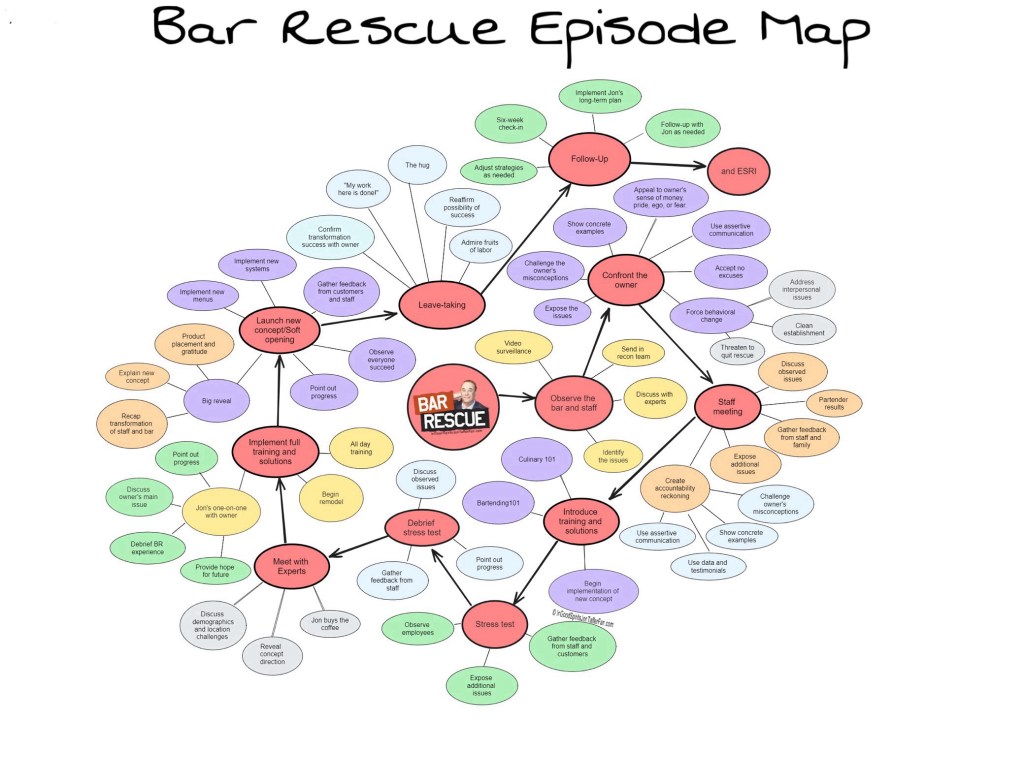
Because the show is mappable like this, viewers sometime think the show is scripted, when it’s not. It is just a well-oiled system that produces consistent results in different situations with great efficiency, and that’s probably because it’s hosted and produced by Jon, a true master of systems.
Jon’s brilliance lies in his ability to see beyond the surface and implement systems that ensure lasting success. His dedication to fixing not just the bars but the people within them, his insistence on consistent standards, and his passion for excellence make him truly one-of-a-kind. Witnessing Jon transform chaos into order is more than a business lesson; it’s a testament to the power of a clear vision, an understanding of the systems that bring the vision to life, and the illustriousness needed to achieve extraordinary results against almost all odds.

 In Good Spirits
Leave a comment