
One Mother’s Day long ago I was gifted a pair of tickets for a Mother’s Day brunch at an upscale hotel bar about 45 minutes from where I lived. I had spent many years, off and on, living with my grandmother because my relationship with my mother was fraught with difficulties.
I came from a working-class background where money was tight, and my early adulthood was marked by financial strain. I was just out of college, working an entry level position, barely making ends meet, and renting a room from my uncle to ease my financial stress. My mother was living in another state at the time, and I was glad because I wanted my grandmother to be my guest at the fancy brunch, and my mother’s absence meant that I didn’t have to choose between her or my grandmother or scrounge up the money for a third ticket.
I say “fancy brunch” because it was very fancy to us. The place was busy, packed with people, all dressed in their fancy clothes and in celebratory moods, although they also seemed stressed because most of them were performing “Happy Mother’s Day” amid the chaos of their unhappy family dramas.
Everyone seemed excited and edgy. They were in their formal outfits, putting on their best behavior in front of their entire family, and being constantly interrupted by children dressed like adults and running loose all over the lobby like gnats swarming around your head on a muggy summer evening in Minnesota (IFYKYK).
The host sat my grandmother and me off to the side and out of the way since we were the only two-top there. Our seating gave us a great vantage point to observe the organized chaos. I found it fascinating because the organized part was not easy to see at first. As it emerged, it was like the curtain was lifted on a whole different scene. Being aware that my brain was able to comprehend this development was a delightful awakening to me.
My grandmother and I sort of clung to one another, watching and commenting on all the gleeful madness that surrounded us. I distinctly remember thinking, “This must be what it’s like at Disney.” I don’t know why I thought that because I had never been to Disney, didn’t especially like anything Disney, and never planned to go to Disney, ever. At the time, I settled on the notion that it was the children running all over the place, thrilled and screaming with delight that evoked thoughts of Disney.
Somehow, though, my young and unworldly self could tell that this fancy event separated itself from all other events I had ever been to because of its customer service; it was totally designed to be about customer satisfaction and enjoyment.
The staff were amazing. They waited on us with a personalized attention we had never gotten at the places we frequented. The amenities were exceptional. The food was exquisite tasting and looking, and, sadly, I was that day old when I grasped the importance of garnishing a dish. Of course, years later, I realized that Disney came to mind because Disney is the epitome of hospitality, and exceptional hospitality was what I experienced that day. I just didn’t have the framework or vocabulary to identify it as such at the time.
Imagine my excitement then, when years later Bar Rescue airs, and I learn all the “bar science” that not only confirms my revised understanding of my Mother’s Day brunch experience but also elaborates on it so that I recall even more details of that lovely day I shared with my grandmother—like how the server always seemed to arrive at the perfect time to refill our drinks.
Then, come to find out, Walt Disney is one of Jon’s inspirations. Jon talks about the importance of having mentors and people who inspire you in his book, Don’t Bullsh*t Yourself! Disney was committed to creating a magical experience for his guests, and for many years as a child, Jon was committed to creating a magical experience for his mother when she was in distress.
Jon tells Dr. Phil that his approach to hospitality, which he labels “reaction management” and which applies to all businesses, was influenced by his days studying cultural anthropology in college. However, Jon had been practicing reaction management for years by helping regulate his mother’s emotional world when she was unable to do it herself. It seems to me that Jon was likely drawn to Walt Disney’s processes because he was doing the same thing, only in a different venue and with a different audience.
I became connected to both Walt Disney and Jon when I became keenly aware of being managed myself by these hospitality processes in a different venue with a different audience and, later on, with Jon’s help. So, Jon, Walt Disney, and I have this interesting little connection on Mother’s Day due to our love for hospitality. Strange how everything comes together, isn’t it?
When I think about Jon and Mother’s Day, I not only think about the warm and exciting experience I had with my grandmother at the fancy bar and all the things I learned about the wonderful level of hospitality there from watching Bar Rescue, but I also think about how Jon advocates for women—and therefore mothers—in direct and indirect ways. His respect extends beyond mere sentimentality and ceremony; it’s deeply rooted in his actions and values and is a reverence likely born from an evolving understanding of the role he plays in the quality of the relationships he’s had with the women in his life, particularly his mother.
As I’ve mentioned elsewhere in this blog, Jon wants women to be safe when they visit, work at, or own bars. He has gone after some sleazy men—and some sleazy women—for being too sexually invasive and inappropriate, and he’s gone after owners for not protecting their female customers and employees and, in some cases, for harassing, humiliating, and/or harming them.
Jon’s concern about women’s safety also extends to their economic security and that of their families. In “S1E1: Fallen Angels,” he informs us that he has a soft spot for single moms, and over the years he has repeatedly shown that he hates when they and their children are financially abused because of mismanagement and irresponsible ownership. And to be real about it, probably 90% of the rescues involve children sucking up the retirement money of their parents and Jon trying to help get it back for them.
Jon is not only a protector of women, but he is also a promoter of them. He brings on female mixologists, female chefs, female interior designers, and female production designers. Just by having women in all the positions of authority around him—and letting their ideas influence him—Jon supports women, most of whom are mothers—and we know that they are mothers because he cares enough to simply ask.
He also has no qualms about helping female bar owners succeed or about promoting female staff into managerial positions. In “S5E11: Ice, Mice, Baby,” Jon plucks Ashley Clark out of her San Francisco bartending job; then he develops her into an expert mixologist and lets us witness her transformation in several episodes over the next couple of years.
One of the qualities I most admire in Jon is the way he lifts up everyone around him. That he so frequently, matter-of-factly, and respectfully includes women is a testament to the fact he sees women as equals. His example is a wonderful gift to women on Mother’s Day and every day.
Fans of Bar Rescue probably know how much Jon likes to fight for something, and he often fights for the children and families of the bar owners when he can’t quite muster the same desire to fight for the owners themselves. This means that Jon is often calling out bad husbands, and I’m not going to lie, it’s beautiful to see them get dressed down for the horrible shit they are doing to themselves and their wives, parents, families, employees, and customers.
Don’t think Jon saves all his wrath for the men, though. To be fair, he is as blunt and straightforward to female owners as he is to the male ones. In “S6E21: Dalia’s Inferno,” he doesn’t even let the fact that the issue is about Dalia’s breasts faze him, going directly to the heart of the matter with as much passion as I’ve ever seen him have.
He also calls out bad wives with just as much gusto and honesty as he does bad husbands. “S5E22: Don’t Cry for Me Jon Taffer” is a great example. At first glance it looks like Jon has to fix owner Richard McClelland, but what Jon eventually discovers is that the problem lies with Richard’s wife, Kristi. Once he figures that out, we get to watch him provide Kristi with a master class in how to change yourself from a “shitty wife” into the “family rock.”
On the other side of the coin, Jon gets especially excited about helping divorced couples who have taken the high road with each other and become amicable for their children’s well-being. That is, after all, what he and his first wife did, and he is proud of it because it preserved his daughter’s relationships with both him and her mother and kept his family together even though his marriage dissolved. Speaking from my own experience and the fact that Jon mentioned on his podcast that he isn’t sure he would recommend that approach, it was also probably crazy hard to do.
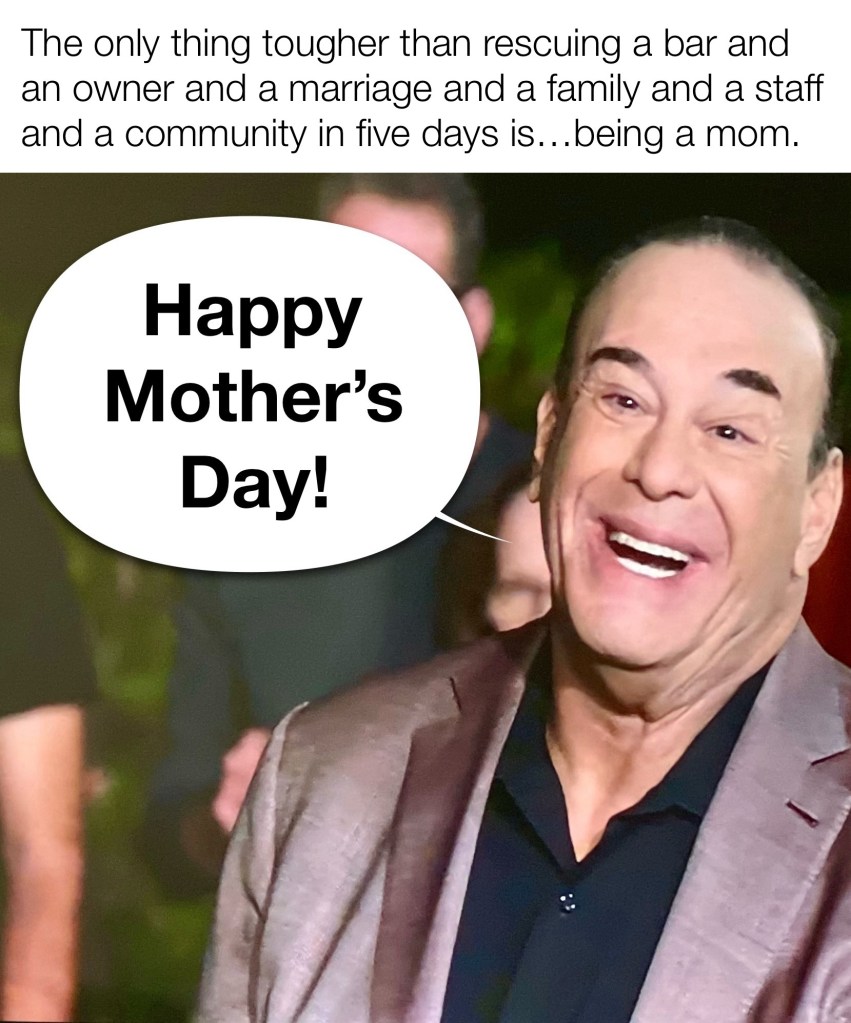
So, in honor of Jon’s support of women in general and mothers in particular, I’ve made a bunch of memes illustrating his support and peppered them throughout this article.
Another aspect of Jon that I admire is that he shares stories that explain how he learned the lessons he imparts. In the introduction to his book, Don’t Bullsh*t Yourself!, he talks about some of the difficulties he experienced with his mother and the impact they had on him. They not only formed the foundation of his approach to relationships with customers and employees but also created the opportunity for his own personal reckoning with excuses, particularly the ones he used to keep himself from talking to his mother for five years, that he calls the “worst excuse I ever made,” and that he says “haunts me to this day.”
Jon rarely shares personal information, but he seems to loosen his standards just a little when talking about his mother. He easily credits her with instilling in him a strong work ethic and the importance of excellence. On occasion he’ll mention more difficult and personal truths about their relationship.
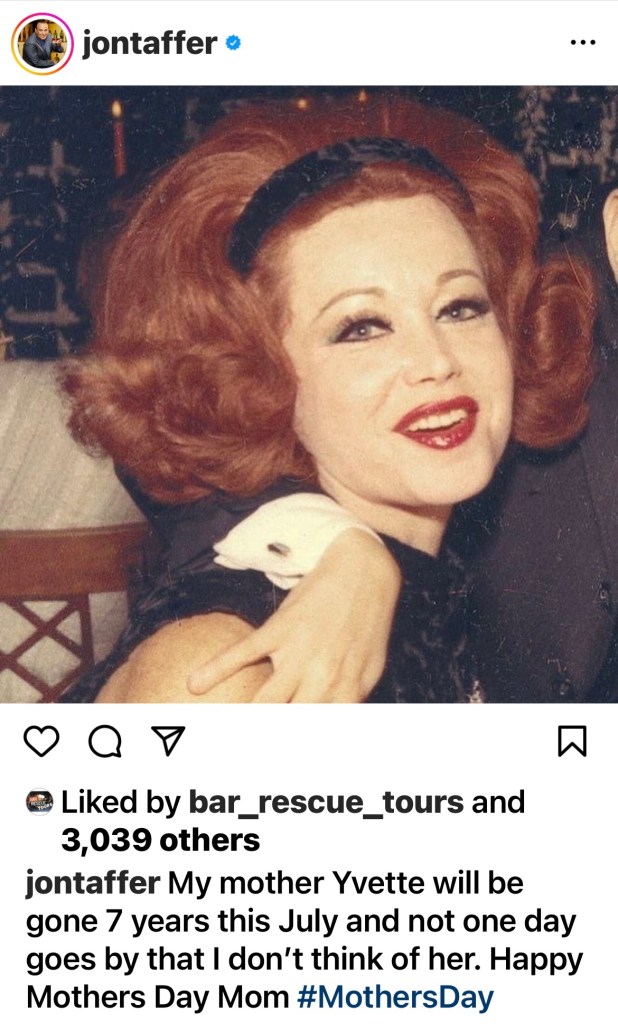
After their relationship restoration and especially after her passing in 2012, he has become more publicly thoughtful, sentimental, and expressive about her—and motherhood in general. He writes of his mother, “No one loved me more than my mother did. The woman who gave birth to me, nurtured me, protected me, and fed and clothed me—no argument is worth abandoning that person.”
In “S8E20: Magically Atrocious,” Jon confesses to owner Lisa Lawson, “I lost my mom just a few years ago, so it was not easy for me to come here and pick on you and your decisions. It was not an easy thing for me to do. You remind me of my mom a little bit, so this was not easy for me.” She wipes away tears as he continues, “So I hope you know everything I said to you, I said out of love and respect and to help you…and look what we did.”
His anguish is as easy to discern as his anger, and I find that both sad and touching. It’s evident that Jon’s relationship with his mother has had a profound impact on him, shaping not only his professional ethos but also his emotional depth and vulnerability. Despite any past difficulties, Jon’s openness about his mother reflects a deep sense of respect, gratitude, and love and underscores the profound influence she had on his life, as well as his ability to hold himself accountable like he teaches us to do.
I extend my heartfelt condolences to Jon. Losing a parent carries with it a deep and persistent sorrow regardless of the nature of the relationship, and the journey of grief is uniquely personal. Jon’s willingness to let us in to that part of his story not only honors the memory of his mother but also offers comfort and empathy to those of us who have experienced similar pains.
On this Mother’s Day, I hope we are all able to recognize and celebrate the profound and hopefully positive influences our mothers have had on our lives. I hope, too, that Jon finds peace and comfort in knowing that his mother’s legacy continues to inspire us through his upstanding character, ongoing successes, and the positive impact he makes on the world. To paraphrase the heartfelt and empowering message Jon gave Doreen Levy (“S6E37: Doreen’s Dilemma”), “You are your mother’s legacy, Jon, and you are quite an illustrious one.”
I invite you to leave your own condolences in the Comments section. Also, as a gentle reminder, this is a tribute blog so please write comments that align with that purpose.

 In Good Spirits
Leave a comment